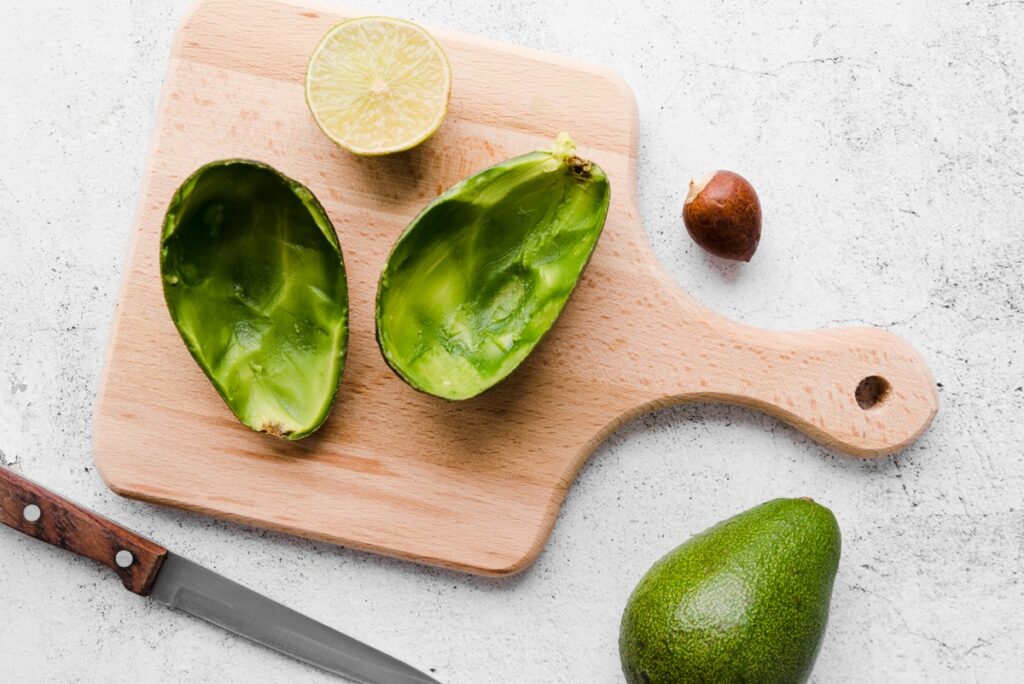
After mashing a ripe avocado for a seasonal guacamole, the same doubt often returns when it comes to throwing away the skin, which is hard and tough and seems to defy the compost.
The fear of seeing it emerge intact months later frequently leads to excluding it from the bin, especially in winter when decomposition seems slowed down. However, this plant casing is not incompatible with returning to the earth.
Well prepared and integrated with method, it can even contribute to the balance of the compost, provided you know a few simple steps to accompany its degradation and prevent it from becoming a lasting intruder.
Composting: what to do with avocado skin?
The thick texture of avocado skin, which is almost leathery, inspires little confidence and the fear of finding it intact months later often leads to choosing the classic trash can.
This mistrust is reinforced in the cold season, when decomposition seems to be at a standstill. Yet, far from being an intruder, this organic residue has every right to return to the earth.
If its degradation seems slow, it is primarily due to its naturally resistant structure, designed to protect the fruit. Rich in fiber and relatively dry, it provides valuable carbonaceous matter that helps structure a compost that is often too wet in winter.
Difficulties mainly arise when it is thrown in whole, limiting the action of microorganisms and delaying its assimilation. Cut up and mixed with the rest of the waste, it ceases to be an obstacle and becomes a useful support for compost life, while helping to reduce the volume of household waste.
The right steps to speed up avocado decomposition
For avocado skin to stop being that waste that resurfaces months later, the first step is to remove its main advantage: its smooth and compact surface.
A sharp knife or a pair of scissors is enough to radically change its destiny in the composter.
The idea is simple: the smaller the pieces, the more attack zones are available to microorganisms, bacteria, and small compost fauna.
By cutting it finely, the protective shell is broken, the internal fibers become accessible, and degradation finally starts at the same pace as more \”accessible\” peelings.
A cut into small fragments, on the order of a few centimeters, often makes all the difference, and this gesture becomes even more useful in winter, when the cold naturally slows down the activity of the composter, especially if it stays outside.
The second key is less about the knife and more about the balance of the bin. Avocado skin, which is rather dry and rich in carbon, plays the role of a brown material that structures a compost that is sometimes too wet, but it cannot work alone.
To avoid a frozen or too dry mixture, it benefits from being associated with wetter waste richer in nitrogen, in order to support bacterial activity and the temperature rise that gradually softens tough fibers. Mixing, layering, and moisturizing as needed: these details directly influence the speed of transformation.
Finally, oxygen remains the engine of the process: without aeration, the pile compacts, suffocates, and fibrous elements \”mummify\” instead of decomposing. Stirring regularly allows for the distribution of moisture, keeps the fragments in contact with the most active zone of the compost, and prevents them from remaining isolated on the colder and drier edges.
As for the pit, it deserves a separate treatment: left whole, it has every chance of surviving in the compost for a very long time, while another path exists, simpler and often more satisfying.
Rather than trying to compost it immediately, it can be transformed into a plant. The pit, designed to last, lends itself very well to indoor cultivation.
Once cleaned, it can be put to germinate in water or in a moist substrate. In a few weeks, roots appear, then a stem, offering an easy-to-keep decorative plant, especially in winter. It is often the simplest and most rewarding option: instead of a quasi-indestructible pit in the compost, you get an indoor plant that fully values this \”waste.\”
Composting can always be considered later, if the plant does not survive or once the pit is weakened by time.